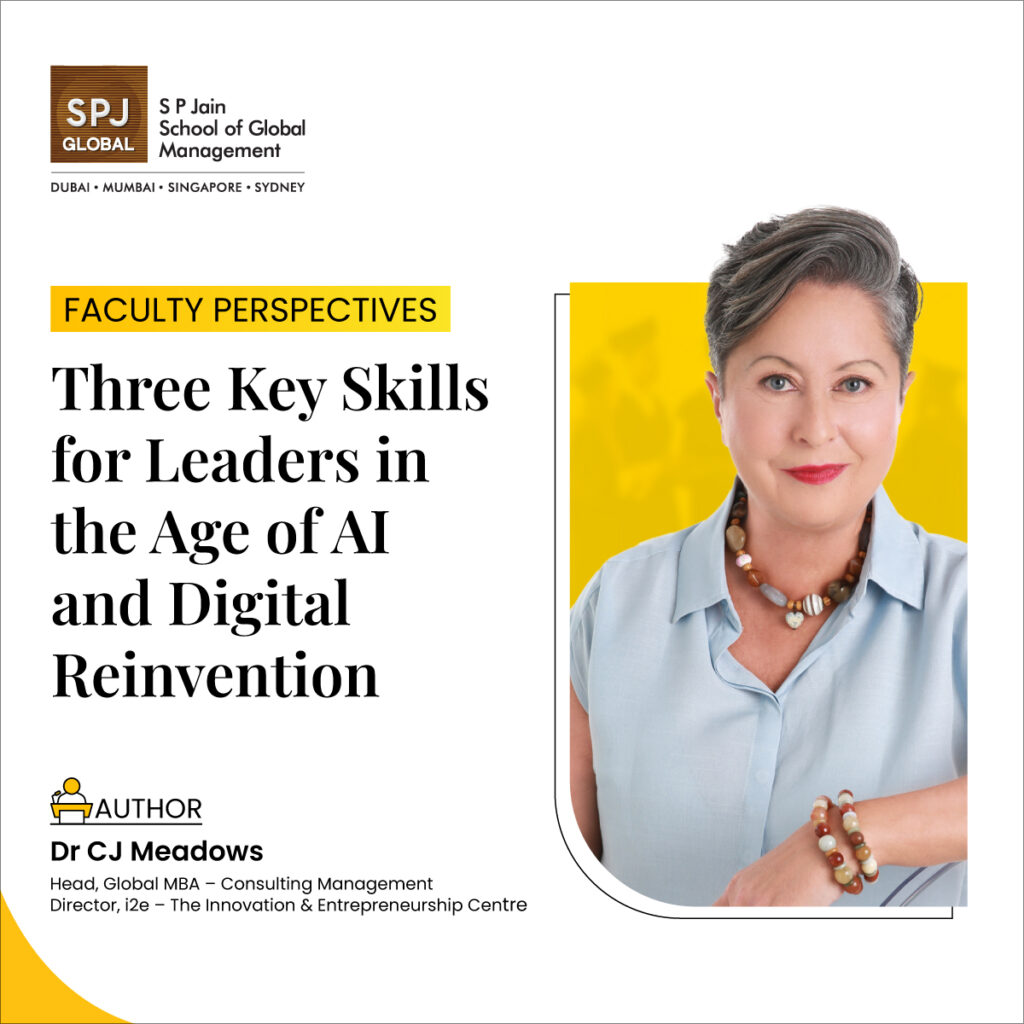
Three Key Skills for Leaders in the Age of AI and Digital Reinvention
“It is not the strongest of the species that survives, nor the most intelligent, but the one that is most adaptable to change.”
—Charles Darwin
Are you – or will you be — an effective and adaptable business leader?
Is leadership itself changing, and how will you learn it?
When I joined Accenture in the 1980s, leaders were focusing on (1) strategic planning and competitive positioning; (2) financial acumen and deal-making; and (3) operational excellence and quality management.
In the 2030s, we’ll need that foundation, plus: (1) innovation and entrepreneurship; (2) AI-native research and learning; and (3) adaptive self- and enterprise-building.
But how can you develop these skills?
Innovation & Entrepreneurship – Starting with Design Thinking
There’s no teacher quite like experience. I lead Design Thinking workshops, where we define problems, identify needs, generate insights, question assumptions, envision a radically new future, design solutions, prototype, and experiment. Participants use my digital twin and SPJ Global’s AI-Enabled Learning Tutor to assist with projects and learn innovation in an innovative way.
We work on projects for real companies, such as Unilever, and global initiatives, including sustainability, informed by design examples and buoyed by engaging exercises. Such corporate experience and sustainability skills are both key to today’s career-building.
But innovations don’t sit on shelves. They’re meant to be used, so executives and venture founders need entrepreneurial skills.
The innovation and entrepreneurship centre I lead provides over 40 mentors/advisors for participants who want to pursue their projects in real life, and my colleagues run entrepreneurship programs for skill- and venture-building. Innovation and entrepreneurship are often pursued in teams, and everyone has the opportunity to lead.
AI-Native Research & Learning
Design Thinking begins with qualitative, primary research into the unknown. But many challenges present the opposite problem – too much is known, and the data presents excessive noise with little insight or understanding.
That’s where humans and AI collaborate at their best, blending human questions, insights, critical thinking, and creativity with AI’s speed, precision, analytics, and scale. When I mentor research projects on student-chosen topics, I help learners integrate qualitative and quantitative data, primary and secondary research, and collaborate effectively with AI.
You can no longer hope to win at innovation – as a leader or an organisation — without such integration.
Adaptive Self- and Enterprise-Building Through Consulting
Consultants, at heart, are learning- and change-junkies.
Thankfully, it’s a good thing now.
Clients need that for themselves and their organisations in this age of hyper-change. Corporate strategy used to be deliberate and planned. Now it’s enhanced – or replaced — by emergent strategy, organisational learning loops, ad hoc structures and cross-functional teams, systemic experimentation, and other means of adaptive enterprise-building.
To help, consultants leverage data, methodologies, and AI while using and honing their human skills to find needs, define problems, organise how to address them, and grow relationships that create value. They drop into a new situation and are called to bring value to people who may have built their entire careers in that one spot.
Consultants learn to be masters of adaptability.
The big firms are hiring more selectively now, but we are seeing a rise in disruptors – including boutiques, individuals, and AI-enabled platform-based services. These new players don’t just compete for consulting clients and employees. They expand the market by addressing previously unserved needs and clients.
If you want to launch or work at one, you’ll need the consulting skillset that’s traditionally learned through experience – hard to break into if you didn’t choose that career trajectory from the start.
As the Consulting Management area head, I mentor students who want to join the field or rise more quickly. I connect them with over 25 advisors, including partners and former partners from the world’s top firms, and I supervise real-world consulting projects for clients like Google, Microsoft, UBS, Samsung, and P&G.
These skills are essential whether you become a consultant, entrepreneur, changemaker, or leader.
How Will You Lead?
You always start by leading yourself. We learn by doing, experimenting, getting feedback, reflecting, co-creating, and collecting ideas, skills, experiences, and connections.
I’ve adapted my leadership style – and myself — since the 80s. I now focus on innovation far more and serve in consultative ways in boardrooms. I embody and share my innovations, research, and learnings through my ventures, writing, speaking, teaching, and mentoring. ‘More influence and ecosystem, less control and hierarchy.
No matter what you lead in your future, keep innovating, learning, sharing — and adapting. You’ll grow into the leader you need for yourself – and for others.
About the author
Dr CJ Meadows is Professor, Director, i2e – The Innovation & Entrepreneurship Center and Head, Global MBA – Consulting Management at SP Jain School of Global Management. To talk to the author’s digital twin about your situation, just visit CJ2.personal.ai. To access the author’s books, articles, speeches, and consulting mentors, go to drcjmeadows.com. To view i2e – The Innovation & Entrepreneurship Centre, with publications, offerings, and over 40 mentors (corporate executives, entrepreneurs, venture capitalists, technologists, designers, and futurists), see i2espjain.org. To check out SPJ Global’s programs, click here.
Recommended Reads:
Generative AI and Future Careers for AI Graduates
How AI and Technology Are Revolutionising Wealth Management
How SP Jain Global prepares a data scientist for the AI-driven future