
Unlearning to Lead: How the EMBA Changed My View of Technology and Leadership
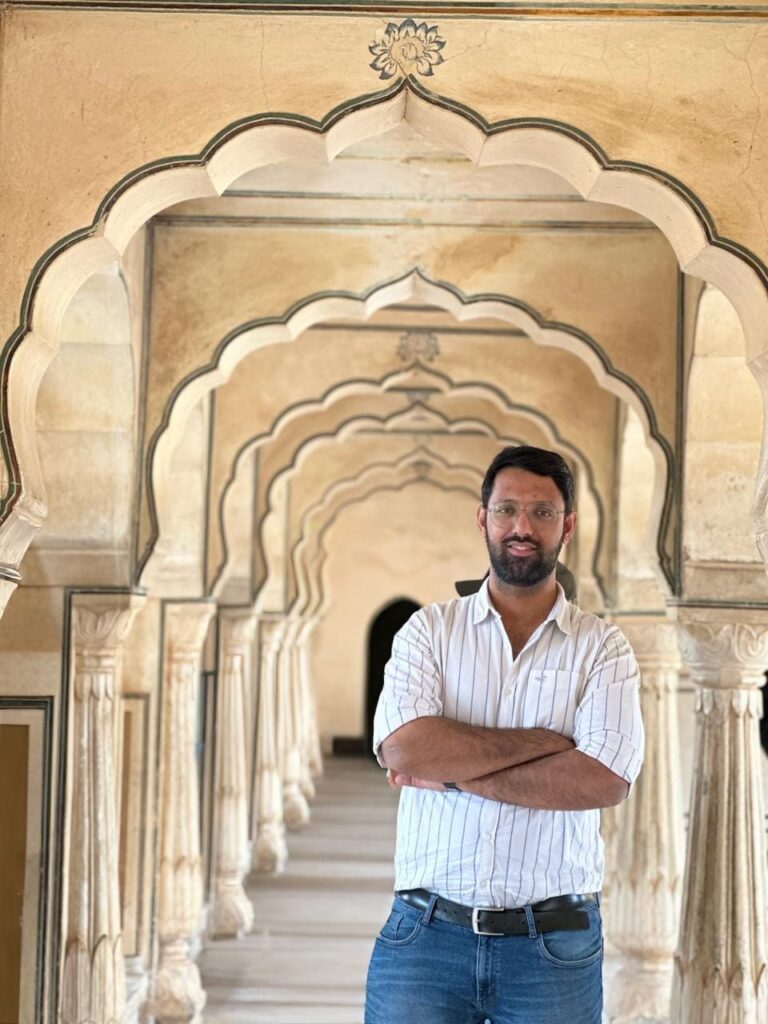
-Gunjit Khera, EMBA 2024 Intake
“The greatest danger in times of turbulence is not the turbulence – it is to act with yesterday’s logic” This line by Peter Drucker stayed with me because it captured something I had begun to feel but could not clearly express.
For a long time, I believed that my logic, refined through years of working in technology leadership roles, was enough to steer me through any challenge that came my way.
I am a seasoned technology professional based out of Delhi, India, with over ten years of experience across e-commerce, healthcare, telecom, and human resources sectors. My journey began as a Performance Test Engineer and gradually evolved into my current role as a Senior Engineering Manager. Along the way, I received accolades at the team, department and company level, which was a result of my hard work and the leadership that recognised it and believed in me. Those experiences shaped my confidence and gave me a strong technical foundation, but they also quietly shaped my belief that technical excellence alone was the key to effective leadership.
Decision to pursue an Executive MBA
Choosing to pursue an Executive MBA after nearly a decade of completing my undergraduate studies was not an easy decision. Balancing work, personal commitments, and studies required sacrifices, discipline, and many late nights. However, enrolling in the program at SP Jain School of Global Management has turned out to be one of the most meaningful and rewarding decisions of my professional life. It pushed me out of my comfort zone and into a space where growth felt both challenging and deeply fulfilling.
Like many professionals in the technology industry, I carried certain assumptions with me. I believed that technology alone could solve most problems; that strong technical knowledge naturally translated into leadership ability; and that business teams often did not fully understand technology constraints. These beliefs were not born out of ego, but instead they were shaped by years of successful project deliveries, late work nights and problem-solving under pressure. Yet, when I stepped into leadership roles that required influence, communication, and strategic thinking, I felt an undeniable gap. It was then that I realised a crucial skill was truly missing, which, due to my then-held beliefs, I never thought would be that important.
Discovering the leadership gap through EMBA
That skill was an all-around leadership ability, and the EMBA journey helped me confront that realisation head-on. Courses such as Personal Effectiveness made me more aware of how I should present myself as a leader, not just through my decisions, but also through my words, presence, and behaviour. Marketing Management changed how I view customer perception and storytelling, helping me understand that value is not just created, but also communicated. Finance courses like Corporate Finance, Management Accounting, and Strategic Finance taught me to look beyond technology KPI’s and appreciate the financial realities that shape every business decision. Operations Management helped me understand that even the most advanced technology platforms depend on strong operational and supply chain foundations.
What made this journey truly special was learning alongside peers from different industries, cultures, and functional backgrounds. Listening to their experiences, working with them on group projects, and debating ideas in classrooms gave me perspectives I would never have encountered in a purely technical environment.
Applying business thinking to real-world challenges
The latter half of the course focused on applying the concepts learned to real-world scenarios. Through case studies on companies and their pivotal, make-or-break decisions, simulations such as the Blue Ocean Strategy simulation, and the Global Strategic Immersion Project (GSIP), I learned to think beyond immediate solutions and focus on long-term impact. I began to see leadership as not just about technology, but also about other aspects, including financial awareness, strategic thinking, cultural sensitivity and strong people skills. This experience made me realise technology is just a small piece in the whole puzzle, that the world’s biggest C-suite leaders are born not just from technological skills but from their excellent people skills, tactical thinking, risk-taking mindset and financial / market awareness.
Today, I find myself approaching leadership very differently. I listen more carefully, think more holistically, and remain open to viewpoints that challenge my own. I take pride in the fact that I no longer see unlearning as a weakness, but as a strength that keeps me relevant and grounded.
Why unlearning is essential for senior technology professionals
For senior technology professionals, unlearning is essential. In a world that changes as rapidly as ours, the willingness to evolve is what separates growth from stagnation. The EMBA course at SP Jain Global has not just enhanced my skills, but it has also reshaped my identity as a leader. I feel more confident, more aware, and deeply proud of the decision I made to invest in this transformational journey and, more importantly, myself!!
A message for the next EMBA batch
To the incoming batch, my message is heartfelt and simple: trust the process, stay curious, and be open to unlearning. The journey will challenge you, but it will also reward you in ways you cannot yet imagine.
About the Author
Recommended Reads:
From curiosity to clarity: My Executive MBA journey with SP Jain Global
Balancing the Mic, Motherhood & an MBA: Maitri’s Story
From Tasks to Strategy: The EMBA Shift I Didn’t See Coming – Aneesha Kochar, EMBA intake of 2024


