
From four internships to a full-time AI role: My two years in MAIB at SP Jain Global
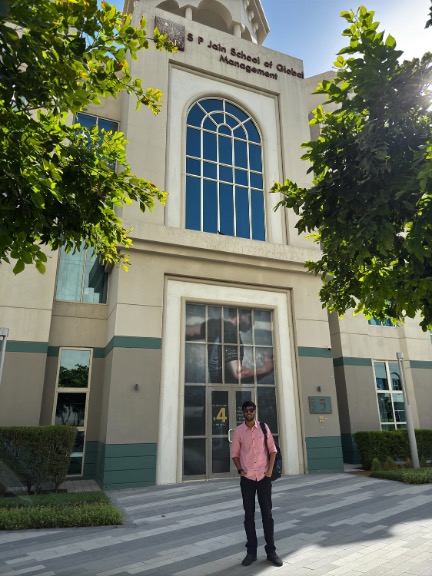
Vidit K Bhatnagar | Master of AI in Business, 2024–2026 | Dubai campus

In August 2024, I resigned from a job I was genuinely good at.
Three years at Celebal Technologies had moved me through four roles, from intern to associate consultant — Microsoft Bot Framework chatbots, an internal SAP assistant running inside Teams, MIS reporting modules, data APIs. By the end of it, I could build almost anything that landed on my desk. What I could not do was tell you whether it was worth building. I had no vocabulary for the business sitting on the other side of the code, and I had started to notice that the engineers who moved fastest in their careers were not the ones who wrote the cleverest systems. They were the ones who could explain why the system mattered.
That gap is why I applied to the Master of AI in Business at SP Jain Global’s Dubai campus.
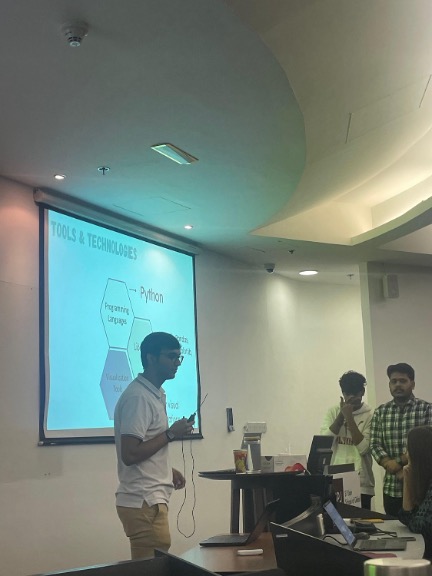
Why MAIB, and not a pure tech degree
I looked at both ends of the spectrum. A pure engineering master’s would have deepened what I already had. A pure MBA would have given me the strategy layer but left the technical edge to rust. MAIB was the only option I found that refused to pick a side.
That blend is the entire point of the program. In the same term you can be pulling apart a frontier model’s architecture and arguing about a company’s market entry strategy. You learn to hold both questions at once — how does this actually work, and why would anyone pay for it — and after two years, switching between the two stops feeling like switching at all. That is what I wanted: to be ready in all formats, not just one.

The turning point: Learners University College
The moment the degree stopped being academic for me was an internship at Learners University College in Dubai, where I joined as an AI Engineer and Business Analyst.
I walked in expecting to support someone else’s AI roadmap. Instead, I ended up owning the AI initiative, which grew into several platforms rather than one. The centrepiece was a learning management system built for the American Global Institute, carrying MBA courses and certification tracks through personalised dashboards, live virtual classes and real-time analytics, with AI automation stripping out a large share of the administrative overhead. Around it came the internal tooling: command-centre dashboards for faculty, student coordinators and administration; a support operations workspace covering ticket routing, SLAs and escalation; an admin assistant that answers operational questions against live platform data; and a curriculum generation tool that authors course content and feeds it straight into the LMS.
There was no senior AI engineer above me to escalate to, no template to follow, and nobody to tell me which ideas were unrealistic. I had to decide what was worth building, build it, and then defend it to people who cared about learner outcomes and institutional growth rather than model architecture. Much of it ran across time zones with international clients, which taught me a second lesson about delivery that had nothing to do with AI at all.
That is where the MAIB classroom and the real world finally met. Every technical decision I made had a business consequence I could now actually see, and every business constraint had a technical shape. It was the first time I understood what the program was training me for.

Building for my own university
My second internship was closer to home. I joined SP Jain Global as an AI Product Development Engineer and built SPJ JPT, the institution’s AI interview and roleplay platform, now deployed across all SP Jain campuses.
It would have been easy to treat this as a showcase for clever AI, and there is plenty of it in there — dynamic question generation, digital avatars, real-time speech and video analytics, performance reports. But the problem that actually mattered was much less glamorous: the platform had to stay up when 500-plus students hit it at the same time during a live interview window, with zero tolerance for a crash mid-interview. A failure there is not a bug; it is the institution’s credibility. So most of the real work went into horizontal scaling, load balancing and monitoring on AWS rather than into making the model smarter. Building something your own classmates depend on is a very effective way to learn what production means.
Futurecraft, and one I cannot name
My third internship was at Futurecraft — the one that would eventually turn into my full-time job, so I will come back to it. The work there was infrastructure-heavy in a way I had not attempted before: GPU-optimised training and inference pipelines, knowledge systems spanning SQL, vector and graph databases, multi-agent workflows built on LangGraph, and the full-stack interfaces sitting on top of them for real-time chat, document ingestion, web scraping and admin monitoring. It was the first time I had to think about AI as infrastructure rather than as a feature.
The fourth was a Product Engineer role at a company I cannot name, building an AI product for the pharmacovigilance sector. Pharmacovigilance is drug safety: the monitoring, reporting and investigation of adverse effects once a medicine is already in use. It is a field where AI is arriving quickly and where the stakes are obvious.
What that work taught me is how differently AI behaves inside a regulated industry. An output there is not simply right or wrong — it has to be auditable, traceable and accountable to a named human being, because a regulator may eventually ask how a conclusion was reached. Nothing in a classroom prepares you for that. Working inside it does.
What I will take from the classroom
Two names, honestly. Dr Anshul Gupta and Dr Rachit Garg are the pillars of whatever I am today as an engineer. They backed me through the entire two years, including the stretches where coursework and internships were running at the same time and something had to give. Faculty who stay in your corner for that long change what you believe you are capable of attempting.no
Alongside them, I had the opportunity to co-author a research paper with Prof. Debashis Guha, Director of the MAIB program — “Multi-LLM Ensemble Learning for Intelligent Payment Exception Resolution”. Going from consuming research to producing it, with the person running the program, was not something I expected to be doing when I applied.
And the curriculum itself held up. It never let me settle into being only technical.
Beyond the classroom
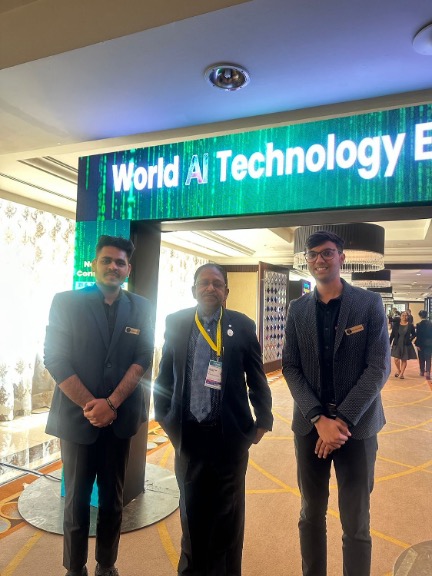
Two years in Dubai also meant two years inside one of the busiest technology markets in the world. GITEX Global and the World AI Technology Expo were a short drive away rather than a flight away, and walking a show floor where every stand is selling an AI product is its own kind of education in what the market actually wants.
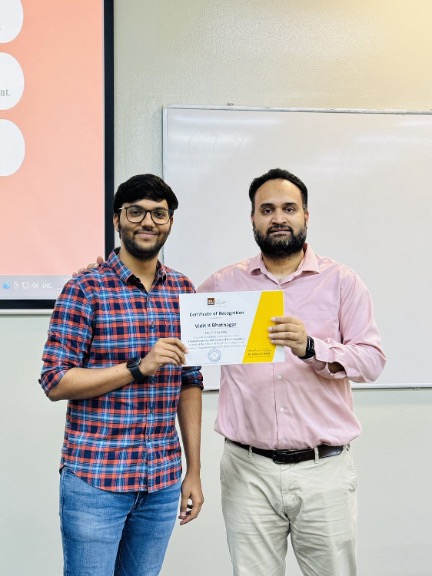
Closer to campus, I served on the Global Learning and Student Life Committee through the 2024–2026 academic year, which the program recognised in July 2026. Some of what I value most from these two years came from that side of the experience rather than from any assessment.
Where it landed
The Futurecraft internship became a full-time offer. I am now an Artificial Intelligence Engineer there.
Two years ago, I was an engineer who could build anything and justify nothing. Four internships and six terms later, what changed is not my stack. It is that I now start every problem by asking what decision this is meant to improve, and for whom. The architecture follows from there.
If you are considering MAIB, my advice is simple: do not treat the internships as a box to tick alongside the coursework. They are where the coursework becomes real. Take the internship where nobody is going to tell you what to do. That is the one that will change your career.

About the author
Vidit K Bhatnagar is a Master of AI in Business (MAIB) graduate from SP Jain Global’s Dubai campus, currently working as an Artificial Intelligence Engineer at Futurecraft.
Recommended:
Why better business questions lead to greater AI solutions
Inside a Startup Internship: MAIB Student Lígia’s Experience at Occuby, Sydney
MAIB Students at SP Jain Global Develops an AI Powered Tool During Internship at GNX


