
Maritime operations to business transformation: Dr Bireshwar Kumar’s DBA journey
Dr Bireshwar Kumar spent his twenties at sea as a Senior Nautical Officer, specialising in navigating commercial vessels along some of the world’s busiest shipping routes, where every decision demanded precision, resilience and the ability to perform under pressure, with mistakes carrying immediate and tangible consequences.
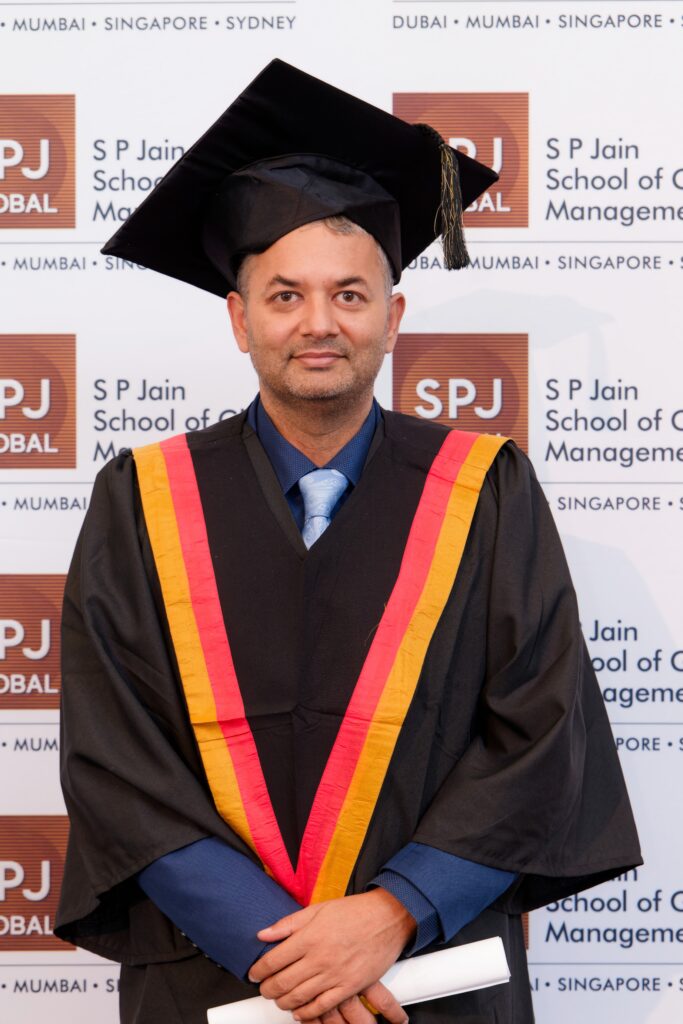
While this experience gave him a strong foundation in operational decision-making and a deep understanding of high-stakes environments, it also revealed a gap in his expertise: knowing how to make decisions was not the same as understanding and critically analysing the complex systems, structures and assumptions behind them.
This realisation became the catalyst for his decision to pursue a Doctor of Business Administration (DBA), enabling him to complement years of practical experience with the analytical rigour and research-driven thinking needed to understand not just how decisions are made, but why they work or fail within organisations. Read on to know about his journey.
How did the DBA prepare you for leading business transformation?
Transformation isn’t just about technology or strategy; it mainly involves people and systems. The DBA gave me frameworks to diagnose organisational problems beyond surface-level issues and fostered a research mindset that encouraged testing assumptions rather than relying on intuition. When I became senior management at a maritime tech start-up, it lacked a commercial infrastructure, including a pipeline, processes, and a team. I built these within eighteen months. The DBA shaped my approach by emphasising the importance of first mapping the system, pinpointing real constraints, and thoughtfully sequencing interventions. This approach differs from the traditional thinking many executives develop through experience.
What inspired your research in cybersecurity and maritime logistics?
I had been involved in maritime operations and logistics for most of my initial career when I realised that the industry’s most significant risks were no longer purely physical. Ships were increasingly becoming connected through integrated navigation, propulsion, cargo, communication, and operational systems, creating new vulnerabilities to cyber threats. However, the cybersecurity frameworks and practices designed to protect these critical onboard systems had not always kept pace with the rapid digitalisation of the maritime industry.
From my operational experience, I recognised that a successful cyberattack on a vessel could have consequences far beyond the loss of IT systems. For example, an attack targeting a ship’s navigation or operational technology systems could disrupt ECDIS, GPS/GNSS, engine or propulsion controls, cargo management systems, or onboard communications. Such an incident could force a vessel to slow down or stop, disrupt its voyage, compromise cargo operations, create safety risks for the crew and vessel, and result in significant financial losses, operational delays, regulatory consequences, and reputational damage to the shipping company.
This situation raised a critical research question for me: how are maritime organisations currently managing cybersecurity risks associated with increasingly connected vessels? Moreover, are their perceived cybersecurity practices actually effective in protecting critical onboard systems and ensuring operational resilience in the event of a cyberattack? I observed a potential gap between formal cybersecurity policies and their implementation in day-to-day maritime operations, which required systematic documentation and analysis.
How has your research shaped your leadership decisions?
It fundamentally changed my relationship with data and evidence. Earlier in my career, I often made decisions through pattern recognition, drawing on years of operational experience and exposure to similar situations. The DBA research process challenged me to examine those instincts more critically and ask: What evidence actually supports this conclusion? Is the pattern genuinely transferable, or is it simply a reflection of the particular environments in which I have worked?
That discipline has changed how I lead. I am more conscious of separating experience from evidence, testing assumptions before committing significant resources, and recognising where my own experience may introduce bias. I also place greater value on structured experimentation, using evidence to test a hypothesis, learning from the outcome, and adapting rather than defending an initial assumption.
In practice, this has made me a more deliberate and evidence-led leader. I still rely on experience and judgement, but I no longer treat confidence as a substitute for evidence. I now ask teams to make the assumptions behind a decision explicit, identify what evidence would validate or challenge them, and establish measurable indicators of success. This has created a stronger culture of experimentation, accountability, and continuous learning in the organisations I lead.
How can organisations stay ahead in an era of rapid digital change?
Stop trying to predict where technology is going and start building the organisational capability to adapt to wherever it lands. The companies I have seen struggle with digital change are those that bet heavily on a specific technology at a specific moment, rather than investing in the human capability, analytical rigour, adaptive thinking and comfort with uncertainty that enable them to respond well to whatever comes next. AI is no exception. The organisations that will benefit most from AI are not those that deploy it fastest. They are those who understand the problems they are trying to solve and can evaluate whether a new technology genuinely addresses them or merely creates the appearance of doing so.
Which DBA experience had the greatest impact on your career?
The supervision process. I had excellent supervisors who did not let me get away with imprecise thinking. They pushed back on vague claims, asked for evidence behind assertions that sounded reasonable, and required me to be specific about the limits of what my research could and could not claim. That habit of distinguishing what you know from what you think you know is one I carry into every boardroom conversation and every strategic recommendation I make. It is worth more than any specific framework or methodology the program taught me.
What advice would you give entrepreneurs considering a DBA?
Do it because you have a genuine research question, not because you want the credential. The DBA is hard; it takes longer than you expect, and the credential alone will not change your outcomes. What changes your outcomes is the quality of thinking the process forces you to develop, and that only happens if you engage with it seriously. If you have a real problem in your field that you want to understand at a deeper level than practice alone allows, the DBA is an extraordinary vehicle for that. If you are doing it to add letters after your name, you will find it a frustrating and expensive way to do so.
My research in cybersecurity and maritime logistics came directly from problems I encountered in practice. The DBA gave me the tools to examine those problems rigorously rather than just respond to them operationally. That combination, practitioner depth plus research rigour, is the thing I would not trade, and the thing I now try to bring into every classroom and every leadership context I am part of.
About the Author
Dr Bireshwar Kumar currently serves as GTM Advisor at Astura Global. He completed his GMBA & PGPM in Global Logistics & Supply Chain Management in 2007 with SP Jain Global, and his Doctor of Business Administration (DBA) in Global Logistics & Supply Chain Management in 2021.
Also read:
How I earned my DBA while balancing work and life
A transformative journey: My DBA experience at SP Jain School of Global Management, SydneyHow does a DBA program prepare senior executives for board-level roles?


