
From technical expertise to strategic business leadership: Abhijit’s EMBA story

I started my Executive MBA at SP Jain Global in 2020 while working in plant quality at a cold rolling mill. My world at that point was specifications, tolerances, and process control. Today, I lead business development and commercial functions for wind energy O&M at Suzlon. The distance between those two roles was covered by the EMBA, and more specifically by the change in thinking it forced.
For most of my early career, I thought like an engineer. Understand the mechanism, fix the problem in front of you, and trust the numbers. That works well on the shop floor. But the EMBA kept pushing me toward a different set of questions, like how a product is priced, how it is perceived, and why a customer chooses it. Based on my merits, I transitioned into a product management role at Tata Steel, sitting between the plant and the market. My job was to improve the product, bring down customer complaints, and build brand recall. It was the first time I had to think commercially rather than technically, and the EMBA had given me the language to do so.
Learning to make better business decisions
The program changed how I make decisions. As an engineer, I looked for the one correct answer. The EMBA taught me to weigh trade-offs and consider second-order effects, such as what a quality call looks like to a customer or how a pricing decision affects next year’s demand. I stopped asking “what is technically right” and started asking “what is the right decision and how do I limit the damage if I’m wrong.” That is essentially what commercial judgement is, and it is the same discipline I later applied when structuring O&M contracts at Suzlon, covering availability guarantees, liability caps, force majeure, and termination terms.
One coursework project stayed with me. I built a market-entry study for UNIQLO entering a new country, working through PESTLE, Porter’s Five Forces, and SWOT, to arrive at a recommendation I had to defend. The frameworks mattered less than the exercise of defending every assumption in front of people who would not let anything slide. The lesson was simple: a business case is only as good as its weakest assumption. I use that every time I put together a commercial position, I know a counterparty will test. A second study on scaling Tata Steelium sales brought me back to my own industry and showed me how different a product looks when you start with the customer and work backwards, rather than starting with what the plant can make. I carried that straight into my product role.
The second piece was more personal, and it became my EMBA thesis. Tata Steelium Super was a brand I helped bring to market, and my final Annual Business Report focused on scaling it. That work forced me to apply everything the program had taught me to something I actually owned, not a case in a textbook. It showed me how differently a product performs when you build it from the customer inward, starting with what the market wants and working back to what the plant should make, rather than the other way round. Watching those principles play out on a brand I was responsible for taught me more than any single lecture, and I carried that thinking straight into every commercial role that followed.
The case-based approach helped because the cases were messy. Incomplete data, stakeholders who wanted different things. That is what real commercial work looks like, not clean textbook problems. It taught me to act on partial information and predict what I was missing. I later relied on that constantly, whether redlining a contract against tender terms or holding a position across the table.

Seeing business problems from different perspectives
The classroom itself taught me as much as the syllabus. I studied alongside people from banking, healthcare, supply chain, and technology. A problem I read as a margin issue, someone from consumer goods read as a branding issue, and a consultant read as a segmentation issue. It was the same problem seen in three different ways, and I learned something from each. It made me look outside my own function by habit, because I saw how much I was missing on my own.
That network, along with what I had learned, led me to move to Jackson Green and into the renewable energy space. From there, a role at Suzlon came to me through people who knew my work, and I took it on in a sector I had come to care about. More recently, I took on a role as BU Head for PPU at Vikram Solar, stepping up to lead a business unit end-to-end. Each move built on the one before, and all of them started with the decision to do the EMBA.
I used what I learned directly on the job. The balanced scorecard, the business model canvas, and stakeholder analysis shaped how I designed value-added service offerings and performance-linked pricing, moving away from flat rates toward incentive and gain-sharing structures. Stakeholder mapping shaped how I handled asset owners, IPPs, and decision-makers in a deal. And the financial grounding meant I could hold my own in a P&L conversation instead of leaving it to someone else.

Advice for experienced professionals considering an EMBA
My advice to experienced professionals considering an EMBA is to pursue it because you are experienced, not in spite of it. The value comes from testing what you learn against the real problems you already carry. You won’t be taught what a P&L is. You will learn to think differently about the one you already run. Go in ready to have your instincts questioned. That is where the value is.
The technical grounding I built over the years still sits under everything I do. The EMBA taught me to use it strategically, to lead with the business question and let the engineering serve it.
About the Author
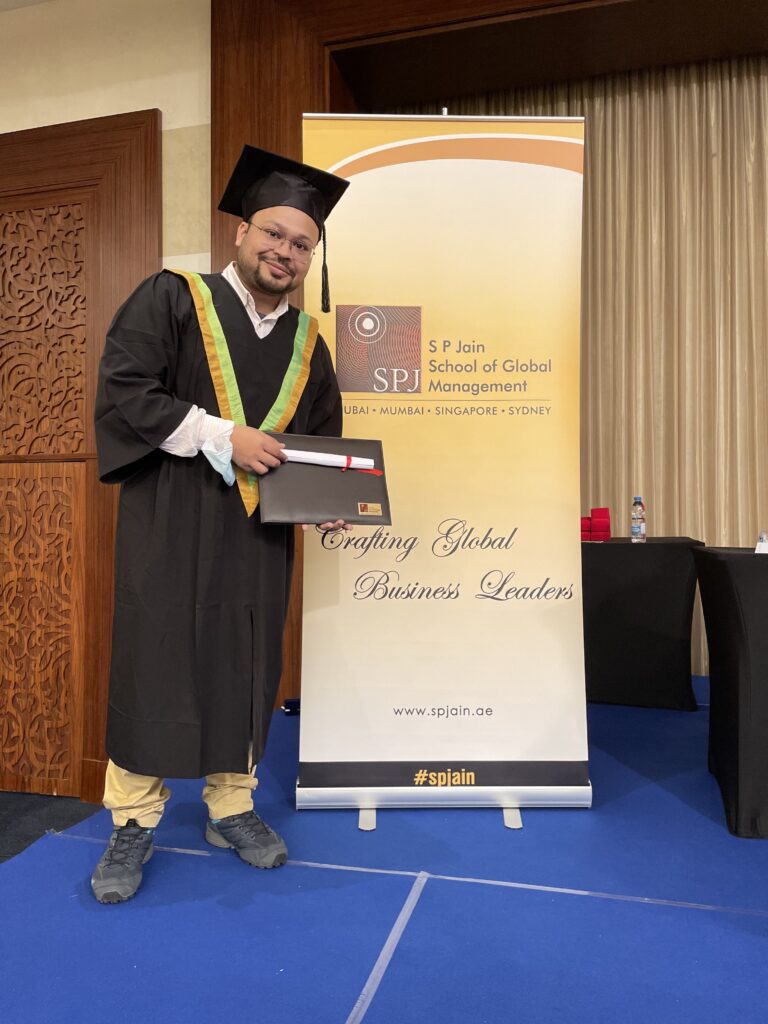
Abhijit Paul is a commercial and business development leader with 14+ years of experience across steel manufacturing and renewable energy, working on wind, solar, and hydrogen O&M contracts and commercial strategy. He completed his Executive MBA at SP Jain School of Global Management (2020–2022) and holds a BTech (Hons) in Metallurgy from NIT Jamshedpur.
Also read:
Leading through transformation: Adil’s EMBA journey in Saudi Arabia’s digital banking era
Engineering with a Business Mindset: Vipul Tailor’s EMBA Experience


